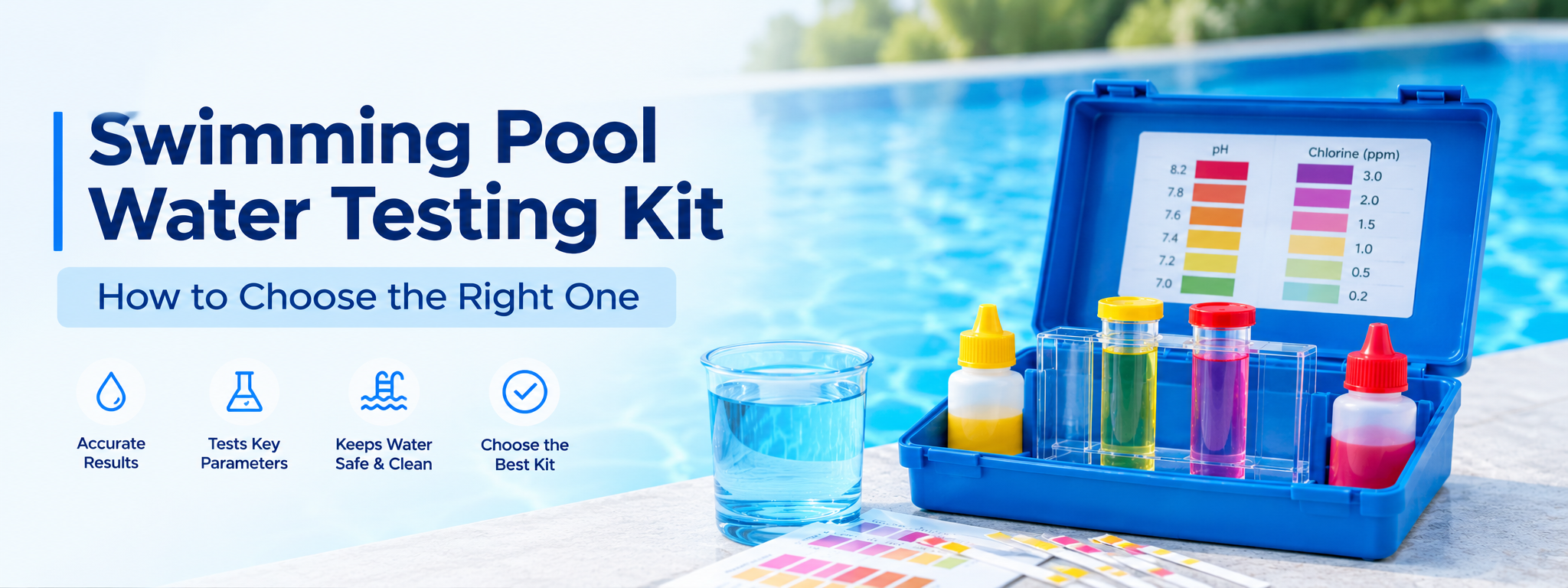
Swimming Pool Water Testing Kit: How to Choose the Right One
24-Aug-2026
Maintaining clean and balanced swimming pool water starts with regular water testing. A good swimming pool water testing kit helps you measure important parameters such as free chlorine, pH, total alkalinity, calcium hardness, and, depending on the kit, cyanuric acid.
But with test strips, liquid reagent kits, digital testers, and multi-parameter pool water test kits available, choosing the right one can be confusing.
The best pool testing kit isn't necessarily the most expensive one. It should measure the parameters your pool requires, provide a suitable testing range, be easy to use correctly, and give results you can trust.
In this guide, you'll learn how to choose a swimming pool water testing kit, what parameters to test, which type of pool test kit is right for your needs, and how frequently you should test your pool water.
Testing gives you information before you add pool chemicals. Instead of adding chlorine, pH increaser, pH reducer, or other chemicals based on guesswork, you can first determine what the water actually needs.
For residential pools, CDC identifies chlorine and pH as key defenses against germs and recommends regularly checking both.
Why Is Pool Water Testing Important?
Pool water can look perfectly clear while its chemistry is out of balance.
For example:
Chlorine may be too low.
pH may be too high or too low.
Alkalinity may be unstable.
Calcium hardness may be unsuitable.
Cyanuric acid may accumulate when stabilized chlorine products are used.
These problems can affect sanitation, swimmer comfort, pool surfaces, and equipment.
CDC recommends maintaining pool pH within 7.0–7.8 and routinely testing disinfectant and pH levels. For residential pools, CDC recommends testing at least twice a day, with more frequent testing during heavy use.
The simple rule:
Test → Understand the result → Adjust the water → Retest.
Free chlorine is the chlorine available to sanitize the water.
It is one of the most important measurements for routine pool maintenance.
CDC recommends at least 1 ppm free chlorine for pools without cyanuric acid and at least 2 ppm when cyanuric acid or stabilized chlorine products are being used, while also emphasizing following product instructions and applicable local requirements.
pH affects both swimmer comfort and chlorine effectiveness.
CDC recommends a pool pH of 7.0–7.8. When pH becomes too high, chlorine becomes less effective; very low pH can increase the risk of corrosion and equipment damage.
Therefore, a basic pool pH test kit is an important part of routine pool maintenance.
3. Total Alkalinity
Total alkalinity helps resist rapid changes in pH.
If alkalinity is not properly balanced, you may find yourself repeatedly adjusting pool pH.
Choose a kit designed for frequent testing, appropriate measurement ranges, and the parameters required by your operating procedures and applicable regulations.
How to Choose the Right Swimming Pool Water Testing Kit
Before purchasing, consider these seven factors.
1. Check the Parameters
Don't buy a kit simply because it says "7-way" or "complete."
Look at the actual parameters included.
At minimum, routine pool testing should address:
Free chlorine
pH
A more comprehensive kit may also include:
Total alkalinity
Calcium hardness
Cyanuric acid
2. Check the Testing Range
The test range should match your pool's expected chemistry.
This is particularly important for commercial pools, pools undergoing corrective treatment, and situations where chlorine may temporarily be much higher than normal.
CDC warns that very high chlorine concentrations can interfere with some chlorine tests and produce misleading results, so the test method and range matter.
3. Consider Accuracy
If you only want a quick indication of whether your pool needs attention, strips may be convenient.
If you're troubleshooting persistent water chemistry problems, a more comprehensive liquid or digital method may be preferable.
Accuracy also depends on:
Correct sample collection
Correct reagent quantity
Clean testing equipment
Fresh reagents
Correct timing
Following manufacturer instructions
4. Check Ease of Use
The best pool water test kit is one you will actually use consistently.
If the kit is complicated and takes too long, you may test less frequently.
For beginners, simplicity can be more important than having every possible test.
5. Check Reagent Shelf Life
For liquid test kits, check the expiration date and storage requirements.
Old or improperly stored reagents can compromise test results.
Keep reagents according to the manufacturer's instructions.
6. Consider Your Pool Type
Your requirements may differ depending on whether you have:
Residential swimming pool
Commercial swimming pool
Hotel pool
Resort pool
Club pool
Saltwater pool
Indoor pool
Outdoor pool
For example, a saltwater pool may require salt-specific testing in addition to standard chlorine and pH measurements.
7. Compare the Cost Per Test
Don't compare only the purchase price.
A kit costing more initially may provide many more tests.
Calculate:
Cost per test = Kit price ÷ approximate number of tests
The right choice depends on your testing frequency and required accuracy.
Best for quick testing
Multi-parameter test strips
Choose these if convenience is your priority.
Best for detailed routine testing
Liquid reagent test kit
Choose a kit that measures chlorine, pH, alkalinity and other parameters relevant to your pool.
Best for numerical readings
Digital pool water tester
Useful when you want electronic results and prefer to avoid subjective color matching.
Best for commercial applications
Choose a professional-grade kit with suitable testing ranges, comprehensive parameter coverage, and procedures that fit your facility's operational and regulatory requirements.
Follow the test-kit instructions for sample depth and location.
Avoid collecting water immediately next to chemical dosing points or from a stagnant area.
Step 2: Use a clean testing container
Residue from previous chemicals can affect the result.
Step 3: Follow the manufacturer's instructions
Use the correct sample volume and reagent quantity.
Step 4: Wait for the specified reaction time
Don't read the result too early or too late.
Step 5: Record the result
Maintaining a simple testing log can help identify recurring water chemistry problems.
Step 6: Adjust chemicals carefully
Only add chemicals based on the test result and the product's instructions.
Step 7: Retest
After making a significant adjustment, retest according to your treatment procedure before making additional corrections.
How Often Should You Test Pool Water?
Testing frequency depends on pool use, weather, water chemistry, and local operating requirements.
For residential pools, CDC recommends testing chlorine and pH at least twice daily, and more often when the pool is heavily used.
Commercial pool operators may need more frequent testing and recordkeeping depending on applicable local requirements and operating conditions. CDC guidance for public pools calls for at least twice-daily testing and more frequent testing during heavy use.
A practical routine is:
Before use: Check key sanitizer and pH levels.
During heavy use: Test more frequently.
After major chemical treatment: Retest according to the product instructions.
After heavy rain or unusual contamination: Check the water chemistry.
During troubleshooting: Test more frequently until the issue is understood.
Pool Water Testing Kit vs Test Strips: Which Is Better?
This is one of the most common questions from pool owners.
Choose test strips if:
You want a fast check.
You are a beginner.
You need convenient routine screening.
You don't require detailed troubleshooting.
Choose a liquid test kit if:
You maintain your pool regularly.
You want more detailed measurements.
You need to troubleshoot water chemistry.
You want to test several important parameters.
Choose a digital tester if:
You prefer numerical readings.
Color matching is difficult.
You test frequently.
The specific device measures the parameters you need.
There is no single winner. The best method is the one that provides appropriate measurements and that you can use correctly and consistently.
Common Pool Water Testing Mistakes
Testing only when the water looks cloudy
Clear water does not guarantee balanced chemistry.
Test the water routinely.
Testing only chlorine
Chlorine and pH are critical, but other parameters may also need monitoring depending on the pool and treatment system.
Ignoring cyanuric acid
If stabilized chlorine is used regularly, CYA can become an important part of water management.
Using expired reagents
Old reagents can produce unreliable results.
Guessing chemical dosage
Always test first and follow the product manufacturer's dosing instructions.
Not recording results
A testing log makes it easier to identify trends and recurring problems.
Using the wrong testing range
A test kit must be appropriate for the concentrations you expect to encounter.
Choose a kit appropriate for residential or commercial use.
If you're buying online, don't select a kit based only on the words “best pool test kit.” Read the actual specification sheet and confirm exactly what the kit measures.
Frequently Asked Questions
What is the best swimming pool water testing kit?
The best kit depends on your pool and testing needs. Test strips are convenient for quick checks, while liquid reagent kits generally provide more detailed testing. Digital testers offer numerical readings but vary in the parameters they measure.
What should a pool water testing kit test?
A basic kit should test free chlorine and pH. A comprehensive pool chemical testing kit may also test total alkalinity, calcium hardness, and cyanuric acid.
Are pool test strips accurate?
Test strips can be useful for routine screening when used correctly. However, CDC states that DPD testing is more accurate for chlorine and pH than strips.
How often should I test my swimming pool water?
CDC recommends checking chlorine and pH at least twice a day for residential pools, with more frequent testing during heavy use. Follow applicable local requirements for commercial pools.
What is the ideal pH for a swimming pool?
CDC recommends maintaining pool pH between 7.0 and 7.8. Always consider your pool chemical manufacturer's instructions and applicable local requirements.
What chlorine level should I test for?
The appropriate chlorine level depends on the pool, disinfectant system, stabilizer use, and applicable requirements. CDC recommends at least 1 ppm in pools without cyanuric acid and at least 2 ppm when cyanuric acid or stabilized chlorine is used.
Can one pool test kit test everything?
Not necessarily. Some multi-parameter kits measure chlorine, pH, alkalinity, hardness, and CYA, while basic kits may measure only one or two parameters. Always check the manufacturer's specifications.
Should I buy a digital pool water tester?
A digital tester can be useful if you prefer numerical readings or test frequently. However, the quality and capabilities vary between devices, so check which parameters it measures and how it should be calibrated and maintained.
Do I need to test cyanuric acid?
If you use stabilized chlorine products such as trichlor or dichlor, CYA testing can be important because these products introduce cyanuric acid into the water.
Final Verdict: How to Choose the Right Pool Water Testing Kit
The right swimming pool water testing kitshould match your pool, chemical system, testing frequency, and required level of accuracy.
For basic routine checks, test strips can provide convenient screening. For more detailed water management, a comprehensive liquid pool water test kit can be a better choice. Digital testers can be useful when numerical readings and convenience are priorities.
Before buying, look beyond the product name and check:
Parameters + testing range + accuracy + ease of use + reagent life + cost per test.
Most importantly, don't wait until your pool becomes cloudy or uncomfortable before testing. Regular measurement of chlorine and pH helps you identify chemical imbalance before it becomes a larger maintenance problem. CDC emphasizes routine testing because chlorine effectiveness depends strongly on maintaining appropriate chlorine concentration and pH.
A simple testing routine, combined with proper filtration, sanitation, circulation, and chemical management, is the foundation of clean and well-maintained swimming pool water.


Leave A Comment