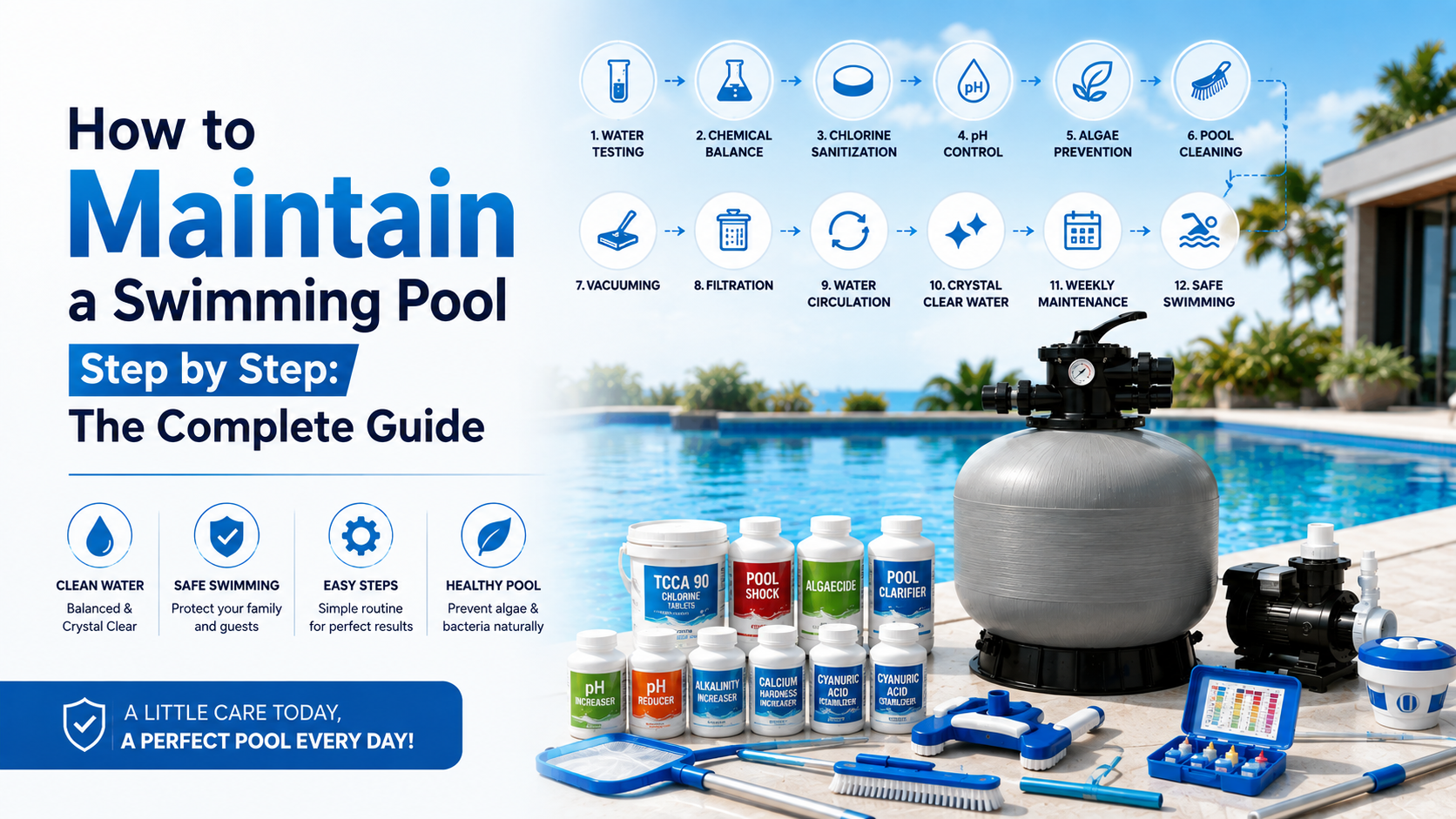
How to Maintain a Swimming Pool Step by Step: The Complete Guide
04-Aug-2026
Owning a swimming pool is one of the best investments you can make for your home, resort, or club — but only if it's maintained the right way. A poorly maintained pool doesn't just look unappealing with cloudy water and algae stains; it can also become a breeding ground for bacteria, damage your pool equipment, and cost you thousands of rupees in avoidable repairs.
The good news? Swimming pool maintenance isn't complicated once you understand the fundamentals. In this step-by-step guide, we'll walk you through everything you need to know — from daily checks to seasonal deep cleaning — so your pool stays crystal clear, safe, and swim-ready all year round.
Whether you're a homeowner with a backyard pool, a facility manager overseeing a commercial pool, or someone researching pool maintenance in India for the first time, this guide covers it all.
Why Regular Pool Maintenance Matters
Before we get into the "how," let's understand the "why." Regular pool maintenance:
Protects swimmer health by controlling bacteria, algae, and waterborne pathogens
Extends the life of your pool equipment, including pumps, filters, and heaters
Saves money by preventing costly repairs and premature equipment replacement
Keeps water crystal clear and inviting, improving the overall swimming experience
Maintains proper chemical balance, preventing skin, eye, and respiratory irritation
Neglecting even one part of the maintenance routine — like your swimming pool filter — can throw off the entire system, leading to green or cloudy water within days.
Step 1: Skim and Remove Debris Daily
The simplest and most overlooked step in pool maintenance is daily skimming. Leaves, insects, dust, and other debris fall into the pool constantly, especially if it's located outdoors near trees or in an open area.
What to do:
Use a long-handled skimmer net to remove floating debris every day
Empty the skimmer basket and pump strainer basket at least twice a week
Brush the pool walls and steps weekly to prevent algae buildup and calcium scaling
This small daily habit reduces the load on your filtration system and prevents organic debris from decomposing and throwing off your water chemistry.
Step 2: Test and Balance Water Chemistry
Water chemistry is the heart of pool maintenance. Even the best swimming pool filter can't compensate for poorly balanced water.
Key parameters to test 2-3 times a week:
Parameter
Ideal Range
pH Level
7.2 – 7.6
Free Chlorine
1 – 3 ppm
Total Alkalinity
80 – 120 ppm
Calcium Hardness
200 – 400 ppm
Cyanuric Acid (Stabilizer)
30 – 50 ppm
Why it matters:
Low pH causes corrosion of metal fittings, ladders, and equipment
High pH leads to cloudy water and scaling on pool surfaces
Insufficient chlorine allows bacteria and algae to thrive
Imbalanced alkalinity causes pH to fluctuate wildly, making the pool harder to manage
Use a reliable test kit or digital tester, and adjust chemicals gradually — never all at once — to avoid overcorrecting.
Step 3: Run and Maintain Your Pool Filtration System
Your pool filter is the single most important piece of equipment for maintaining clean, clear, and safe water. It's responsible for physically removing dirt, oils, sunscreen residue, and microscopic particles that chemicals alone can't handle.
Types of pool filters commonly used in India
There are three main types of filtration systems: sand filters, cartridge filters, and DE (diatomaceous earth) filters. Among these, FRP (Fiberglass Reinforced Plastic) sand filters are by far the most popular choice for Indian homes, resorts, and commercial pools because of their durability, corrosion resistance, and low maintenance needs. If you're comparing options, this detailed swimming pool filter buying guide breaks down everything you need to know before choosing the right FRP filter for your pool size and usage.
Understanding top mount filters with multiport valves
Most modern FRP sand filters use a top mount pool filter with a multiport valve — a single control valve on top of the filter tank that lets you switch between Filter, Backwash, Rinse, Waste, Recirculate, and Closed modes without any complicated plumbing changes. This design makes day-to-day operation and maintenance dramatically simpler compared to older side-mount systems. To understand exactly how this works and why it's become the industry standard, read our detailed explainer on what a top mount pool filter with a multiport valve is, along with its features, benefits, and uses.
Weekly filter maintenance checklist
Check the pressure gauge — if the reading is 8-10 PSI above the clean starting pressure, it's time to backwash
Backwash the filter by turning the multiport valve to the "Backwash" position and running it until the sight glass water runs clear
Rinse the system for 30-60 seconds after backwashing to resettle the sand bed properly
Inspect the sand media every 3-5 years, and replace it if it appears compacted, dirty, or clumped
Check for leaks around the valve, unions, and tank fittings
Signs your filter needs attention (or replacement)
Even well-maintained filters have a lifespan. Watch out for persistent cloudy water despite correct chemical levels, frequent pressure spikes, cracks in the tank body, or sand escaping into the pool through the return jets. These are all warning signs worth knowing — our guide on the signs your swimming pool filter needs replacement explains each symptom in detail and helps you decide whether a repair or a full replacement is the smarter choice.
If your current filter is underperforming, upgrading to a high-quality, corrosion-resistant unit can make maintenance significantly easier. You can explore a full range of FRP swimming pool sand filters and compare specifications on the pool filter page to find the right size and flow rate for your pool.
Step 4: Run the Circulation System for Adequate Hours
Your pool pump and filter should run long enough each day to turn over the entire volume of water at least once — ideally 1.5 to 2 times.
General rule of thumb: Run the system for 6-8 hours daily, split across two or three cycles (e.g., morning, afternoon, and evening) rather than one continuous stretch. This improves circulation, prevents dead spots where algae can form, and reduces electricity costs compared to running the pump non-stop.
Step 5: Shock the Pool Periodically
Even with regular chlorination, organic contaminants like sweat, sunscreen, and body oils build up over time and create chloramines — the compound responsible for that strong "chlorine smell" many people mistake for cleanliness (it's actually a sign of dirty water).
Shock treatment involves adding a large dose of chlorine (or a non-chlorine shock) to rapidly oxidize these contaminants.
Shock your pool once a week during heavy-use season
Always shock after heavy rain, a pool party, or visible algae growth
Run the filter continuously for 24 hours after shocking
Step 6: Clean the Waterline and Pool Surfaces
Oils, lotions, and minerals leave a visible ring at the waterline over time. Left unaddressed, this buildup becomes a magnet for bacteria and algae.
Use a waterline-specific pool cleaner and a non-abrasive brush weekly
Vacuum the pool floor manually or with an automatic pool cleaner at least once a week
Brush tile grout lines monthly to prevent calcium and algae buildup
Step 7: Monitor Water Level
Water levels naturally drop due to evaporation, splashing, and backwashing. If the level drops too low, it can cause the pump to run dry and burn out — an expensive mistake that's entirely preventable.
Keep the water level at the midpoint of the skimmer opening at all times, topping it up with a hose as needed.
Step 8: Seasonal and Deep Maintenance
Beyond daily and weekly tasks, your pool needs periodic deep maintenance:
Monthly: Inspect and lubricate O-rings and gaskets on the filter valve and pump lid
Quarterly: Check the multiport valve for smooth operation and inspect the pressure gauge accuracy
Annually: Fully drain and inspect the filter tank, replace worn sand media if needed, and get pump seals checked by a professional
Pre-monsoon/pre-summer: Do a full chemical rebalancing and equipment inspection before peak usage seasons begin
Common Pool Maintenance Mistakes to Avoid
Ignoring the filter pressure gauge until water quality visibly deteriorates
Adding chemicals directly without pre-dissolving them, which can damage pool surfaces
Over-relying on chlorine while neglecting pH and alkalinity balance
Skipping backwashing until the filter is severely clogged, straining the pump motor
Choosing an undersized or poor-quality filter that can't handle the pool's actual water volume
Quick Reference: Daily, Weekly, and Monthly Pool Maintenance Checklist
Daily
Skim debris off the surface
Check water level
Run the filtration system for 6-8 hours
Weekly
Test and balance pH, chlorine, and alkalinity
Backwash the filter when pressure rises
Brush walls, floor, and waterline
Vacuum the pool
Monthly
Deep-clean the skimmer and pump baskets
Inspect filter valve O-rings and gaskets
Check for leaks or unusual noises from the pump
Seasonally/Annually
Replace filter sand media (every 3-5 years)
Full equipment inspection before summer/monsoon
Professional servicing of pump and filter system
Frequently Asked Questions (FAQs)
How often should I backwash my pool filter?
Backwash whenever the pressure gauge reads 8-10 PSI above its clean starting pressure — typically once every 1-2 weeks for regularly used pools, though this varies with usage and debris load.
What is the best type of pool filter for Indian weather conditions?
FRP (Fiberglass Reinforced Plastic) sand filters are widely recommended in India because they resist corrosion, UV damage, and temperature fluctuations far better than metal alternatives. Learn more in our FRP pool filter buying guide.
How do I know if my pool filter needs replacing rather than repairing?
Persistent cloudy water, cracks in the tank, sand leaking into the pool, and frequent pressure spikes despite regular backwashing are all signs replacement may be more cost-effective than repair. Full details are covered in our guide on the signs your swimming pool filter needs replacement.
What does the multiport valve on a top mount filter actually control?
A multiport valve lets you switch the filter between multiple operating modes — Filter, Backwash, Rinse, Waste, Recirculate, and Closed — using a single lever, without altering any pipework. Read our full breakdown on top mount pool filters with multiport valves.
How many hours a day should a pool pump and filter run?
Most residential and commercial pools need 6-8 hours of filtration daily, split into two or three cycles, to achieve at least one full water turnover.
Can I maintain my pool without a professional?
Yes, daily and weekly tasks like skimming, chemical testing, and backwashing can be done by pool owners themselves. However, annual deep maintenance, sand media replacement, and equipment troubleshooting are best handled by a qualified pool technician.
Conclusion
Maintaining a swimming pool doesn't have to be overwhelming. With a consistent daily and weekly routine — skimming, testing water chemistry, running the filtration system, and keeping an eye on your equipment — your pool can stay clean, safe, and inviting throughout the year.
At the center of it all is your filtration system. A well-maintained, correctly sized FRP sand filter with a top mount multiport valve does the heavy lifting of keeping your water clear, so your chemical routine works the way it should. If your current filter is old, underperforming, or showing signs of wear, browse Pearl Water's full range of FRP swimming pool sand filters to find a durable, efficient replacement built for Indian pools and climate conditions.


Leave A Comment