


28-Apr-2026
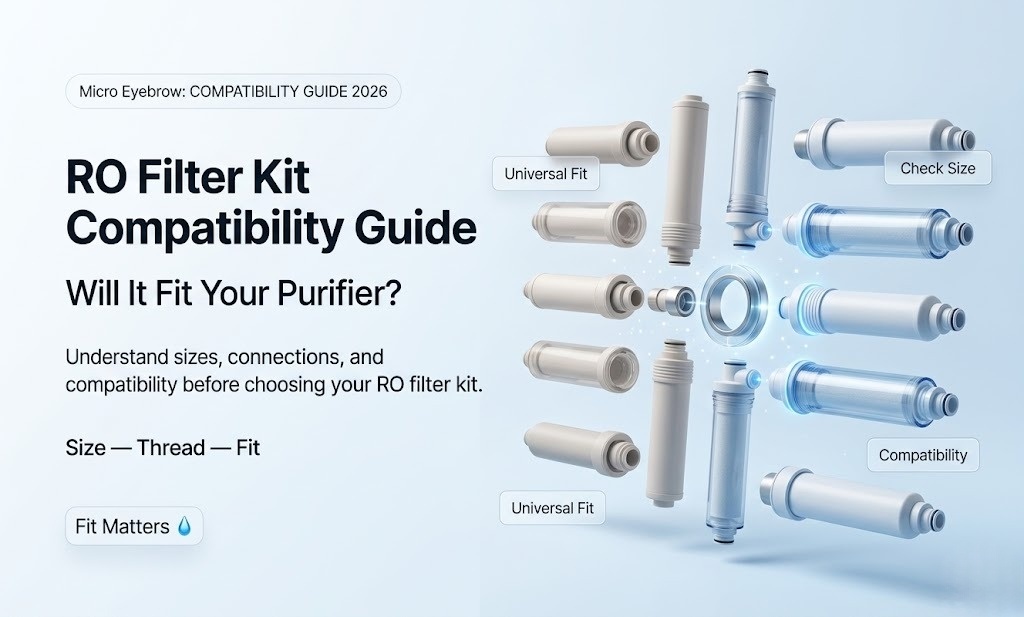
Living in India means dealing with a highly unpredictable water supply. Whether you rely on hard borewell water, municipal supply, or dusty tanker water, your RO purifier works overtime. But what happens when it’s time to change the filters?
You go online, search for a replacement, and are instantly bombarded with hundreds of options. You buy one, wait for the delivery, and when you try to install it—it simply doesn't fit.
Buying the wrong ro filter kit is a common and frustrating issue for Indian homeowners. It wastes your time, your money, and leaves your family drinking unsafe water while you wait for a replacement. With so much compatibility confusion surrounding different RO brands like Kent, Aquaguard, and Livpure, how do you know which kit is right for you?
In this comprehensive 2026 guide, we will break down everything you need to know about compatibility, from cartridge sizes to micron ratings, so you never waste money on the wrong filter again.
At its core, RO filter kit compatibility simply means whether the replacement parts you buy will physically fit and correctly operate inside your specific water purifier machine.
Not all water purifiers are built the same. When you purchase a water purifier filter kit, you need to ensure that it matches your machine in three main areas:
If even one of these factors is mismatched, your new ro filter kit will be useless. A compatible kit ensures zero leaks, optimal water pressure, and 100% safe drinking water.
When shopping online, you will generally come across two distinct categories of filter kits. Understanding the difference is the first step to making a smart purchase.
Universal kits are designed to fit the vast majority of standard, unbranded, or cabinet-style water purifiers assembled in India. If your purifier has a generic body design, chances are a universal ro water purifier kit will fit perfectly. These kits use standard inline filters with common 1/4-inch push-fit connectors. They are highly cost-effective and readily available.
Many top-tier brands use proprietary designs to force customers to buy their specific replacements. These filters might have a unique "twist-and-lock" mechanism or a custom shape that won't accept standard universal filters. If you own a premium, highly customized model, you will likely need a brand-specific water purifier kit.
Before you hit the "Buy Now" button, you need to understand the technical specifications that determine whether a kit will work for you. Here is a breakdown of the crucial factors:
The size of your filter is the most obvious compatibility factor.
The tubing inside your RO system carries water from one filter to the next. Standard domestic purifiers use 1/4-inch pipes and fittings. Always ensure your new kit comes with standard 1/4-inch push-fit elbows.
The micron rating determines how tightly the filter blocks dirt and particles.
RO membranes are rated in GPD (Gallons Per Day). Standard home purifiers use a 75 GPD or 80 GPD membrane. If you live in a joint family or have high usage, you might use a 100 GPD membrane. Ensure the flow restrictor (FR) in your new kit matches your membrane's capacity.
If you are confused about whether a standard ro filter set will work with your branded machine, use this quick 2026 reference guide:
RO Brand |
Compatibility Type |
Notes on Replacement |
Kent |
Mostly Universal / Some Proprietary |
Older Kent models (like Grand/Supreme) easily accept a standard 10-inch inline ro filter. Newer smart models may require specific branded parts. |
Aquaguard |
Mostly Proprietary |
Many modern Aquaguard models use custom twist-and-lock active copper cartridges. Standard universal kits rarely fit without severe modification. |
Livpure |
Mixed |
Basic models accept standard inline filters. Premium models often require custom-shaped filters. |
Pureit |
Proprietary |
Pureit highly relies on GKK (Germkill Kits) which are strictly brand-specific. |
AO Smith |
Proprietary |
Uses custom-sized filters and specific electronic alerts. Standard kits are not recommended. |
Many buyers make easily avoidable mistakes when purchasing a filter kit online. Here are the top errors that lead to high return rates:
The bulky housing outside your main RO machine holds the pre filter cartridge. This component plays a massive role in your system's overall compatibility and health.
Why does the pre-filter matter so much?
A standard external bowl will always take a standard 10-inch spun or thread-wound pre-filter.
What happens if you force an incompatible or poorly matched kit into your machine? It hits your wallet hard.
A mismatched kit leads to internal leaking, which can short-circuit the electrical components (like the pump or SMPS). Furthermore, if the micron rating is wrong, fine silt will pass through and permanently destroy your expensive RO membrane.
By choosing the correct, compatible parts, you drastically reduce your ro service kit price and long-term maintenance costs. Paying attention to compatibility means you won't be calling a technician every two months, saving you heavily on the overall water purifier service kit and ro filter set price.
Prices have stabilized in 2026, but buying individual filters is still far more expensive than buying a complete combo. Here is a general breakdown of what you can expect to pay online vs offline:
Item |
Average Online Price (INR) |
Technician Offline Price (INR) |
ro kit price (Basic Spun + Carbon) |
300 - 500 |
600 - 900 |
ro filter kit price (Full Inline Set) |
600 - 900 |
1,200 - 1,800 |
ro all filter price (With Membrane) |
1,200 - 2,500 |
3,000 - 4,500 |
water purifier filter price (Single) |
150 - 300 |
350 - 500 |
Note: The filter kit price varies based on brand and quality.
DIY vs. Technician Cost: Buying a compatible ro kit online and installing it yourself (DIY) saves you the standard technician visiting charge of 300–500, plus the massive markup they add to the spare parts.
When you look at a box, the cartridge filter specification can look like a math equation. Let's simplify it.
The most common specification you'll see relates to the micron rating. But what is the difference in daily usage?
Don't guess. Follow these steps to guarantee that your new water purifier filter price investment doesn't go to waste:
As a water treatment expert with 10+ years of experience dealing with Indian water conditions (where TDS frequently ranges between 500 to 2000 ppm), here is my strongest advice:
Never compromise on the quality of your filters just to save fifty rupees. Always look for ISO-certified manufacturing. In India, municipal water can suddenly turn muddy during the monsoons, and borewell water TDS fluctuates in the summer.
A high-quality, perfectly compatible ro water purifier filter ensures your machine doesn't choke during these harsh seasonal changes. I highly recommend checking out ISO-certified options that guarantee perfect fittings and heavy-duty filtration. You can trust reliable platforms like Pearl Water to provide standard, high-quality kits that match your needs.
1. Will any RO filter kit fit my purifier?
No. While universal kits fit about 80% of unbranded or standard cabinet purifiers, premium brands like Aquaguard or Pureit often require proprietary, brand-specific filter kits.
2. What is RO filter kit price in India?
In 2026, a basic pre-filter kit starts around ?300, while a complete ro filter kit price (including sediment, carbon, and RO membrane) ranges between ?1,200 to ?2,500 online, depending on the quality and brand.
3. How to check cartridge filter size?
Turn off the water supply, open your RO cabinet, remove one of the inline filters (like sediment or carbon), and measure its length with a standard ruler. Most domestic filters are 10 inches long.
4. What is difference between 5 micron and 10 micron?
A 10-micron filter has slightly larger pores and is great for catching visible mud and sand. A 5-micron filter has tighter pores, making it ideal for blocking ultra-fine silt and microscopic dust particles.
5. What is ro service kit price?
A complete ro service kit price usually falls between ?600 and ?1,500 online for standard parts, but hiring a technician for a full service including parts can cost anywhere from ?1,500 to ?3,500.
6. Do I need a 20 inch filter cartridge for my home?
No, a 20-inch cartridge is meant for commercial water purifiers or whole-house systems. Standard home kitchen ROs require 10-inch cartridges.
Navigating the world of RO maintenance doesn't have to be a headache. By understanding the difference between universal and brand-specific designs, measuring your cartridge filter size, and paying attention to the micron ratings, you can easily become an expert at maintaining your own machine.
Buying the right water purifier filter kit not only ensures that your family drinks 100% safe, clean water, but it also dramatically increases the lifespan of your expensive RO membrane.
Don't let compatibility confusion cause you to waste money on the wrong parts. Take a minute to check your machine's specifications today.
Ready to upgrade your system with a perfectly compatible, premium filter kit? Explore a highly reliable, ISO-certified RO filter kit tailored for challenging Indian water conditions.
For more tips on maintenance and to compare the latest market rates, be sure to read our detailed guide on the RO filter kit price in India. Keep your water pure and your maintenance costs low!
Leave A Comment