Added to wishlist.

How Does a Pool Filtration System Work?

17-Sep-2026

How Does a Pool Filtration System Work?

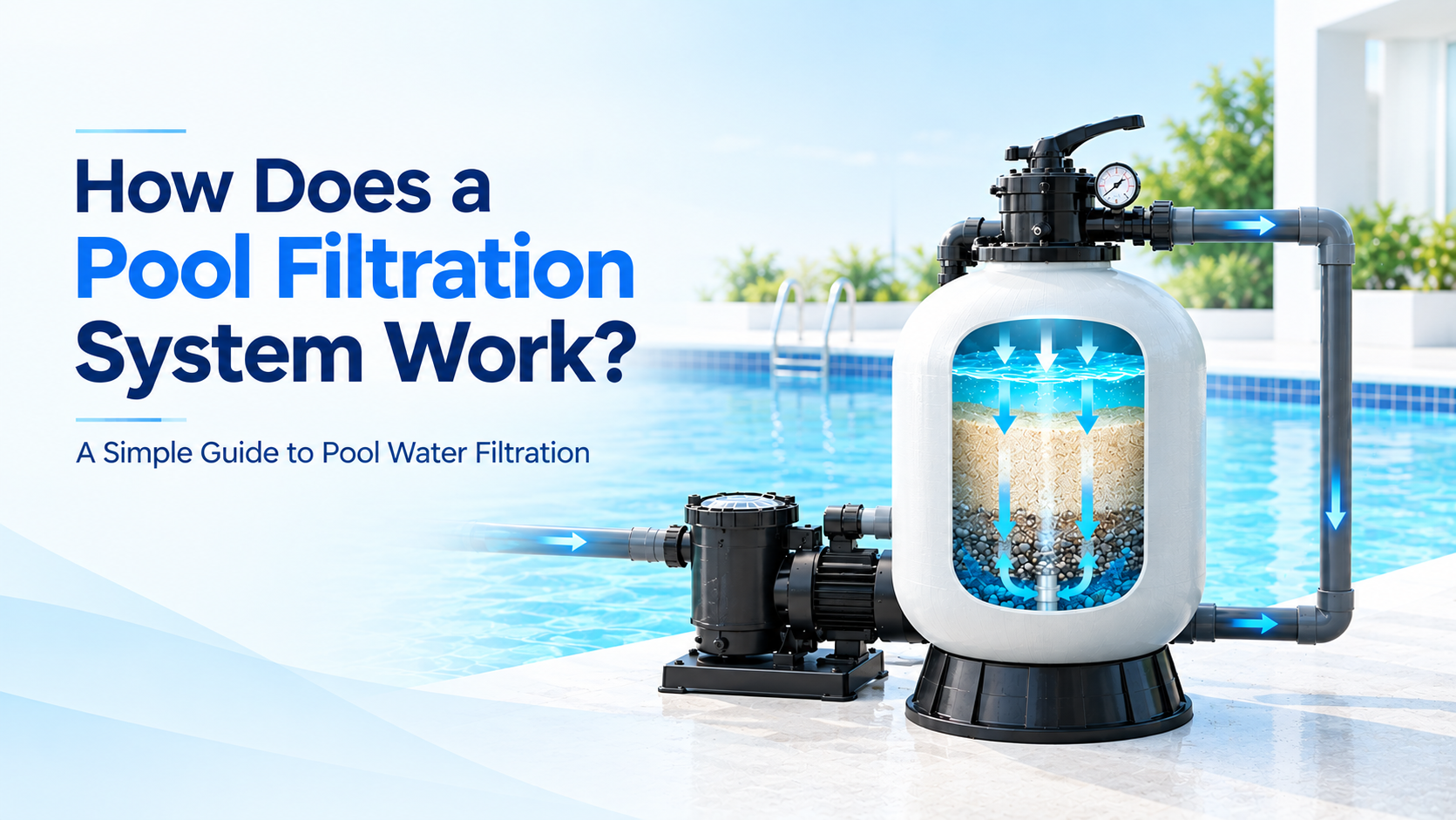
Quick answer: A pool filtration system works by continuously pulling water out of the pool, forcing it through a filtration medium under pressure to trap dirt and debris, and returning clean water to the pool — repeating this cycle until the pool's entire water volume has passed through at least once (a "turnover"). The pump creates the pressure, the filter medium (commonly silica sand in an FRP tank) does the actual trapping, and the valve and plumbing direct where the water goes at each stage. For a typical residential pool, one full turnover takes roughly 6–8 hours of daily filtration.

The rest of this guide walks through the actual physics of that process, with a worked example, so you can understand not just what happens but why it takes as long as it does.


Tracing a Single Drop of Water Through the System

  1. Intake: A drop of water near the surface is drawn into a skimmer opening (or from the main drain on the pool floor), pulled by suction created by the running pump.

  2. The pump: The drop travels through the pump's impeller, which converts the motor's rotational energy into water pressure and flow, pushing the drop onward.

  3. Into the filter tank: Under this pressure, the drop enters the top of the filter tank and is forced downward through the filtration medium.

  4. Mechanical trapping: As the drop moves between grains of silica sand, any dirt, algae, or debris it's carrying gets caught in the narrow gaps between sand particles — this is mechanical filtration, physically too small a gap for particles above a certain size to pass through.

  5. Exit through the underdrain: The now-cleaner drop reaches the bottom of the tank and exits through the underdrain/lateral system into the multiport valve.

  6. Return to the pool: In "Filter" mode, the valve directs the drop back through the return line and out through a return jet, re-entering the pool — cleaner than when it left.

This entire journey typically takes seconds per cycle, but a pool's entire water volume completing this journey once is what's called a "turnover" — and that's where run-time calculations come in.


The Physics: Why Sand Filtration Actually Works

Sand filtration relies on two combined mechanisms, not one:

  • Straining: Particles larger than the gaps between sand grains are physically blocked — the most intuitive part of the process.

  • Adsorption and depth filtration: As the sand bed accumulates a thin layer of trapped debris (called a "filter cake"), that layer itself becomes part of the filtration surface, catching progressively finer particles than the clean sand alone could. This is actually why a lightly used filter sometimes filters better than a freshly backwashed one — some filter cake improves filtration quality, up to the point where too much raises pressure and restricts flow.

This is also why backwashing removes the filter cake — restoring flow rate — but why a completely fresh backwash cycle can briefly return slightly less-fine filtration until a small amount of cake rebuilds.


Worked Example: Calculating Your Actual Turnover Time

Here's the real math behind "how long should I run my filter":

Example pool: 40,000 litres, filtered by a filter rated at 8,000 litres/hour (8 m³/hr)

Turnover time = Pool volume ÷ Filter flow rate 40,000 L ÷ 8,000 L/hr = 5 hours for one full turnover

Most professionals recommend at least one full turnover per day for residential pools, and some recommend closer to 1.5–2 turnovers during heavy-use periods (parties, hot weather, high bather load) — so this pool would ideally run for 5–10 hours daily depending on usage.

This calculation is also the fastest way to check whether your filter is actually sized correctly for your pool — if your filter's rated flow rate can't achieve at least one turnover within a reasonable daily run time, it's undersized for your pool volume. Compare your pool's volume against Pearl Water's FRP filter range, from the 400mm 6 CBM model for small pools up to the 650mm 16 CBM for larger ones.


What Controls Each Stage of the Process

Stage

What Controls It

What Goes Wrong If Undersized/Faulty

Water intake

Skimmer/main drain design, strainer basket condition

Restricted flow before water even reaches the pump

Pressure & flow

Pump size and condition

Filter never receives its full rated flow rate

Trapping debris

Sand grade and bed depth (filter tank)

Poor filtration despite adequate flow

Mode control

Multiport valve

Wrong mode sends unfiltered water back to the pool

Return distribution

Return jet placement/plumbing

Uneven circulation, "dead zones" of stagnant water

Understanding the valve's role specifically is worth a closer look — our guide on what a top mount pool filter with a multiport valve does explains exactly how each valve setting redirects this process.


Why Filtration Alone Isn't Enough

The filtration process described above removes physical particles — it does nothing to kill bacteria or control algae growth biologically. That's the job of pool chemicals (chlorine or another sanitizer), working in parallel with, not instead of, filtration. A well-run filtration process actually reduces chemical demand, since less organic debris in the water means less sanitizer consumed neutralizing it. Our guide on pool pH vs chlorine explains this relationship, and our pool chemicals range covers the sanitizing side of the process.


Keeping the Process Running Correctly Over Time

The filtration process gradually degrades between maintenance actions — a rising pressure gauge reading signals filter cake buildup restricting flow, which is resolved by backwashing (briefly reversing the whole process to flush trapped debris out through the waste line). Over years, the sand medium itself wears down and needs full replacement, since worn sand grains change the pore size the entire straining process depends on.

For the complete maintenance schedule that keeps this process working as designed, see our step-by-step swimming pool maintenance guide. If the process seems to be failing despite proper maintenance, our guide on signs your swimming pool filter needs replacement will help you determine why.


Frequently Asked Questions

How long does it take for a pool filter to clean the whole pool?

This is your "turnover time" — calculated as pool volume divided by filter flow rate. A 40,000-litre pool with an 8,000-litre/hour filter takes 5 hours for one full turnover; most residential pools benefit from 1–2 turnovers daily.

Does filtered water mean the water is fully clean?

No — filtration removes physical debris, but water sanitization (killing bacteria, controlling algae) is a separate chemical process handled by pool chemicals like chlorine, working alongside filtration rather than replacing it.

Why does my filter need to run for hours, not minutes?

Because "clean" means the pool's entire water volume has passed through the filter at least once, and a filter only processes a fraction of that volume per minute — the total run time is simply pool volume divided by flow rate.

Why does backwashing briefly reduce filtration quality?

Backwashing flushes out the "filter cake" — a thin layer of trapped debris that had actually been helping catch finer particles. Once removed, filtration briefly returns to using clean sand alone until a small amount of cake naturally rebuilds.

What actually stops working first when a filtration system fails?

Most commonly, it's a specific stage rather than the whole system — a clogged strainer basket restricting intake, a worn pump losing pressure, sand media that's compacted or depleted, or a valve leaking at the seals. Diagnosing which stage is affected is usually faster than replacing the whole system.

Is a bigger filter always better for the process?

Not necessarily — the entire process (pump, plumbing, valve) needs to be rated to match a larger filter's flow rate. An oversized filter tank paired with an undersized pump doesn't actually filter faster; it just adds cost without improving the real turnover time.


Why Trust This Guide

This guide is published by Pearl Water Technologies, a manufacturer of FRP swimming pool filtration systems supplying residential, hotel, resort, and institutional pools across India. The process explanation and turnover calculations above reflect the same engineering principles we apply when specifying and sizing filtration systems for our own customers. For model-specific flow rates, always check the datasheet of the exact filter you're considering on our pool filter product range.

Share:

Leave A Comment

Thank You for subscribing our newsletter.