Clean water isn't optional — but raw tap water, especially from borewells or older municipal supply, often carries dissolved salts, heavy metals, and contaminants you can't see or taste directly. Reverse osmosis (RO) remains one of the most effective and widely used ways to deal with that, and the RO membrane is the single component doing the actual work of removing what's dissolved in the water.
This article breaks down exactly what role the membrane plays, how it fits alongside the other filter stages in your purifier, and what to actually look for when choosing one.
How Water Moves Through an RO Purifier
An RO purifier doesn't rely on the membrane alone — it's a multi-stage system, and each stage exists to protect the one after it:
1. Pre-Filters — Before water ever reaches the membrane, it passes through a sediment filter (removing sand, dust, and rust) and a carbon filter (removing chlorine and odour). This isn't just about improving taste early — chlorine specifically damages an RO membrane over time by degrading its filtration layer, so a worn or skipped pre-carbon stage directly shortens the membrane's usable life.
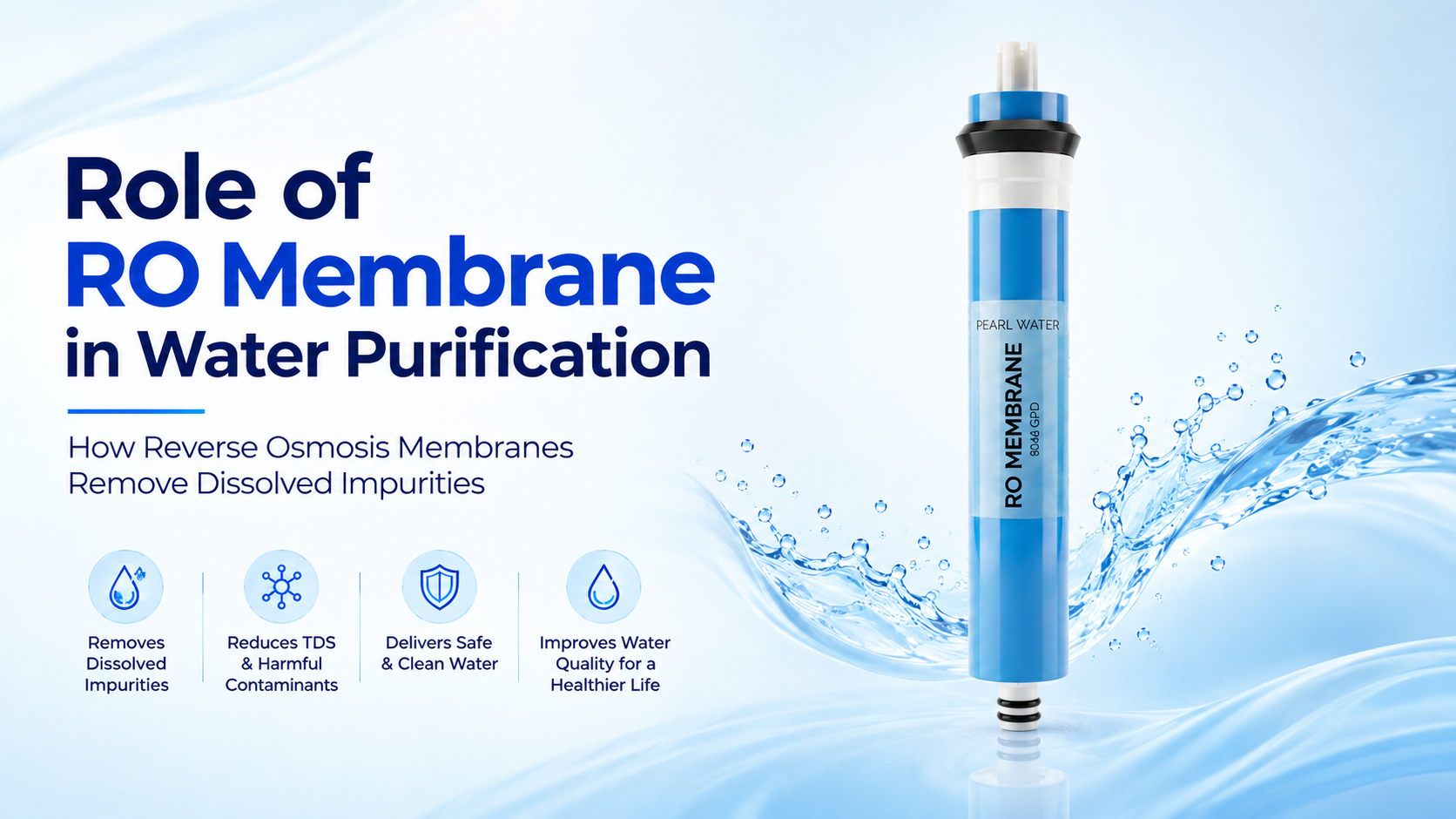
2. The RO Membrane — This is where the real purification happens. Under applied pressure, water is forced through an ultra-thin semi-permeable layer that blocks dissolved salts, heavy metals, and other contaminants while letting purified water pass through. For the full mechanism — what's actually happening at a molecular level — see How Does the RO Membrane Actually Remove TDS? and What Is an RO Membrane and How Does It Work?
3. Post-Filters — After the membrane, many systems add a post-carbon stage as a final taste polish. By this point TDS is already removed, so this stage is purely about improving the taste and mouthfeel of the finished water.
What the RO Membrane Actually Does
It removes excess TDS. Total Dissolved Solids — the dissolved salts and minerals that make water taste salty, metallic, or "hard" — are reduced by roughly 90% or more through a properly functioning RO membrane, depending on the specific membrane's rejection rate and condition.
It removes harmful contaminants. Bacteria, viruses, heavy metals, and other impurities that can cause waterborne illness are filtered out at the same time, which is why RO remains one of the most trusted purification methods for genuinely unsafe water sources.
It's the most expensive filter stage — for good reason. RO membrane price sits above sediment or carbon filter cost because it's doing fundamentally more complex work — removing dissolved contaminants that physical filtration alone can't touch.
How Long Does the Membrane Actually Last?
A well-maintained domestic RO membrane typically lasts 12–24 months, though this depends heavily on your water source and how well the pre-filters ahead of it are maintained. Rather than guessing, the reliable way to check is testing with a TDS meter — comparing input and output readings tells you your membrane's actual real-time performance. For the full picture on lifespan and what shortens it, see How Long Does an RO Membrane Last? and Common Problems with RO Membranes and How to Solve Them
RO Membranes from Pearl Water
Pearl Water has been manufacturing water and wastewater treatment equipment in India for over a decade, and our domestic RO membrane filter elements are tested across all critical parameters to ensure consistent performance for their full rated lifetime.
80 GPD RO Membrane Classic (15 LPH) — effectively removes heavy metals, minerals, and other soluble salts, rated for feed water up to 1000 PPM TDS. Our most popular domestic membrane.
RO Membrane 20 LPH Ultra — a higher-capacity option for households wanting faster purification and cleaner output.
Not sure which fits your household? See our full buying guide, or browse the complete Domestic RO Membrane range. If you'd rather replace your sediment, carbon, and membrane stages together, a complete RO Filter Kit is usually the simplest option.
FAQs
1. What is the role of the RO membrane specifically, compared to the other filters?
Sediment and carbon filters remove particles and chlorine/odour respectively, but neither reduces dissolved TDS. Only the RO membrane removes dissolved salts, heavy metals, and similar contaminants — it's the stage that actually purifies the water, not just pre-treats it.
2. Does the RO membrane work without the pre-filters?
Technically it can still filter water, but without pre-filtration, chlorine and sediment reach the membrane directly and shorten its life significantly — the pre-filter stages exist specifically to protect it.
3. How much does an RO membrane reduce TDS by?
Typically around 90% or more, depending on the specific membrane's rejection rate and how well-maintained the whole system is.
4. Why is the RO membrane the most expensive part of the filter system?
Because it's doing the most complex job — removing dissolved contaminants at a near-molecular level, not just physically blocking particles the way sediment and carbon filters do.
5. How do I know when my RO membrane needs replacing?
Test with a TDS meter periodically — rising output TDS is the clearest, earliest sign, often before flow rate or taste changes become noticeable.


Leave A Comment